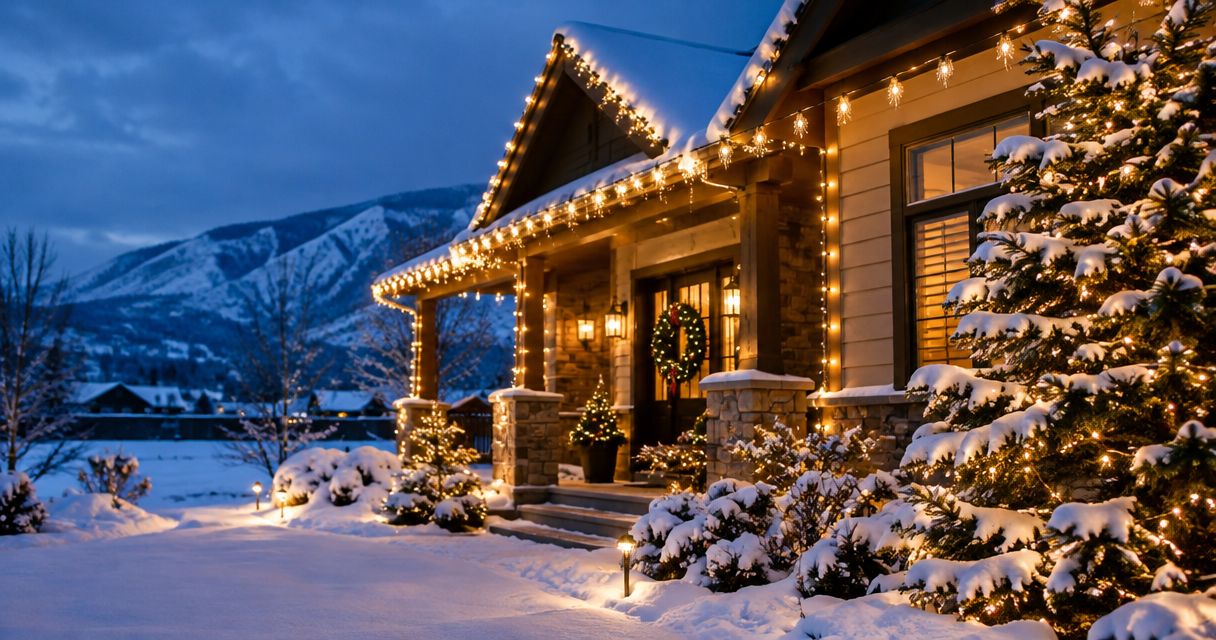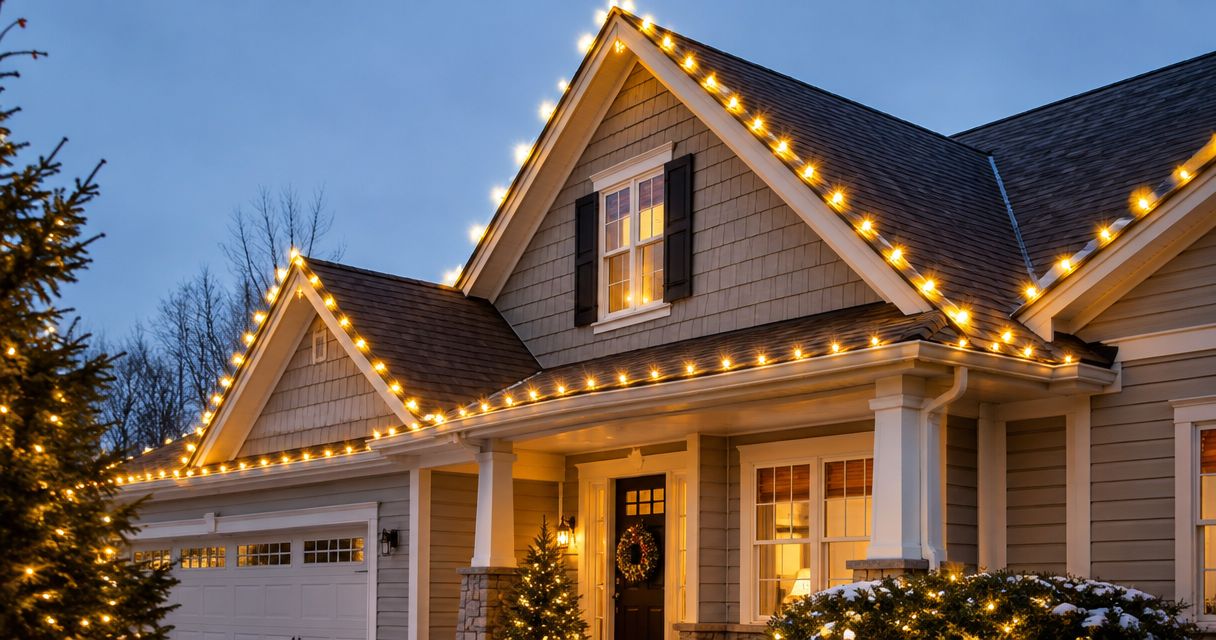
Best overall: LED mini string lights. Best for rooflines: C9-style LED lights. Best for shrubs: LED net lights. The best LED Christmas lights for energy savings in 2026 combine low total wattage with a layout you actually want; this guide ranks lighting formats, not individual products.
- The best LED Christmas lights for energy savings are LED mini strings when their total wattage suits your design.
- Choose C9-style LED lights for defined rooflines and LED net lights for evenly covered shrubs.
- Compare total input watts and operating hours, not bulb count or an LED label alone.
- SOK Lighting suits homeowners seeking Christmas light design, installation, maintenance, takedown, and storage.
Why this matters
A low-wattage strand does not guarantee a low-energy display. Add enough strands, extend the nightly schedule, or illuminate areas nobody sees, and total electricity use rises. Choose the display first, then compare the watts needed to create it.
For homeowners in Nampa, Meridian, Boise, and Eagle, SOK Lighting handles custom Christmas light design, installation, maintenance, takedown, and storage. That addresses ladders, tangled strands, and seasonal storage. Selecting an energy-efficient lighting specification is a separate decision from choosing who installs it.
For your 2026 display, compare both the lighting and the work involved. A strand that draws less electricity but does not fit the roofline is not automatically the better purchase.
What makes the best LED Christmas lights for energy savings?
Use these criteria before choosing a format:
- Total input wattage: Compare the complete connected display, including power supplies where applicable. A bulb count is not an energy measurement.
- Useful coverage: Choose lights that outline or cover the intended surface without unnecessary overlap.
- Operating schedule: Specify when the lights turn on and off. Lower wattage and shorter operating time both reduce energy use.
- Outdoor suitability: Use lighting, connections, and controls rated for the intended environment. Follow the manufacturer's installation instructions.
- Serviceability: Check replacement procedures, connection limits, and whether a failed section can be addressed without replacing the entire layout.
- Visual fit: Decide whether you want a fine sparkle, a defined roof edge, hanging light, or even shrub coverage before comparing specifications.
These criteria guide the ranking below. No lighting format wins every application, and no format guarantees the lowest wattage across all products.
LED Christmas lights at a glance for 2026
| Rank and lighting format | Best for | Standout feature | Key limitation |
|---|---|---|---|
| 1. LED mini string lights | Flexible, detail-focused displays | Small light points suit wrapping and outlining | Dense coverage can require multiple strands |
| 2. C9-style LED lights | Defined rooflines | Larger bulb shape creates a clear outline | Bulb shape alone says nothing about power draw |
| 3. LED net lights | Even shrub coverage | Connected grid spreads lights over foliage | Fixed dimensions do not fit every shrub |
| 4. LED icicle lights | A hanging eave effect | Vertical drops create texture below an edge | Drops add lights beyond the horizontal outline |
| 5. LED rope lights | A continuous-looking border | Enclosed light points follow a defined route | Unneeded length adds energy use without useful coverage |
The ranking prioritizes matching the format to the job. Compare actual product wattages before treating any row as an energy winner.
1. LED mini string lights: best for flexible, detailed displays
LED mini string lights place small light points along a flexible cord. You can use them to wrap branches, trace an entry, or add detail to a compact display. They are the default choice when you want flexibility rather than a prominent bulb shape.
LED mini string lights pros:
- Flexible strands accommodate different shapes.
- Small light points suit close-up detail.
- Separate strands let you divide the design into distinct areas.
LED mini string lights cons:
- Dense wrapping requires more connected length.
- Thin-looking coverage can tempt you to add unnecessary strands.
- Untangling and storing loose strings remains part of DIY ownership.
Best for: Homeowners decorating branches, railings, and smaller features rather than creating a bold roofline.
Choose the intended spacing before you buy. A loosely wrapped tree and a densely wrapped tree are different electrical loads, even when both use the same type of LED string.
Compare complete layouts rather than individual strands. If one option needs extra strings to achieve the desired appearance, include those strings in the wattage calculation.
Verdict: Buy LED mini string lights for adaptable detail; skip dense wrapping that adds little visible value.
2. C9-style LED lights: best for defined rooflines
C9-style LED lights use a larger decorative bulb shape suited to outlining a roof edge. They create individual points along the building rather than the finer texture of mini lights. Choose them for that visual role, not because the C9 name promises a particular wattage.
C9-style LED lights pros:
- Larger bulb shapes create a distinct roofline pattern.
- Individual light points make the outline the main feature.
- A defined route helps keep the design focused on selected edges.
C9-style LED lights cons:
- C9 describes a bulb format, not an energy specification.
- Roofline access adds installation and removal work.
- Similar-looking products can have different electrical requirements.
Best for: Homeowners who want the roofline to carry the display without filling every nearby surface.
Check whether the specification lists watts per bulb, per strand, or for the complete assembly. Those measurements are not interchangeable. Include every connected section before comparing the roofline with another design.
Do not replace an attractive, restrained outline with more lighting solely because the new bulbs are LEDs. The additional connected load still counts.
Verdict: Buy C9-style LED lights for a deliberate roofline; skip any option without clear electrical specifications.
3. LED net lights: best for evenly covered shrubs
LED net lights connect light points in a grid that drapes over foliage. Their main advantage is placement: the grid establishes a pattern without wrapping a separate strand around each part of the shrub. Energy use still depends on the installed product and how many nets you connect.
LED net lights pros:
- A grid distributes light points across a surface.
- The format reduces individual strand-routing decisions.
- Separate nets can define individual planting areas.
LED net lights cons:
- Fixed dimensions can leave gaps or excess material.
- Overlapping nets adds load and concentrates light.
- Irregular shrubs do not always match a rectangular grid.
Best for: Homeowners decorating shrubs whose shapes and dimensions suit the net.
Measure the intended coverage before selecting the net. Do not judge fit from the package photograph. A net that must be folded over itself is not delivering all its light to the intended surface.
For energy savings, avoid treating overlap as the solution to every fit problem. A different format can be a better choice for an irregular planting.
Verdict: Buy LED net lights for well-matched shrub coverage; skip them when substantial folding or overlap is necessary.
4. LED icicle lights: best for a hanging eave effect
LED icicle lights combine a horizontal support strand with hanging illuminated drops. They add a different shape to the display: light extends beneath the eave rather than sitting only along its edge. Choose that effect intentionally because the drops are additional illuminated material.
LED icicle lights pros:
- Hanging drops create a recognizable seasonal pattern.
- The format adds vertical detail beneath an edge.
- A single lighting format supplies both horizontal and hanging elements.
LED icicle lights cons:
- Drops can tangle during removal and storage.
- Hanging sections need suitable clearance.
- The extra illuminated length must enter the energy comparison.
Best for: Homeowners who specifically want hanging light beneath an eave or covered edge.
Compare the input watts for the whole installed run. Measuring only the horizontal roof edge does not describe all the illuminated length in an icicle display.
If a simple outline already delivers the appearance you want, hanging drops are an optional addition rather than an energy-saving requirement.
Verdict: Buy LED icicle lights for the hanging effect; skip them when a simple outline meets the brief.
5. LED rope lights: best for continuous-looking borders
LED rope lights enclose light points inside a flexible outer tube. They suit a defined border where you want a continuous-looking line rather than separated decorative bulbs. Follow the product's bend, mounting, and cutting instructions instead of assuming every rope behaves the same way.
LED rope lights pros:
- The enclosed format keeps light points together.
- A defined route supports a restrained border design.
- The visual effect differs clearly from individual roofline bulbs.
LED rope lights cons:
- Bend limits restrict some corners and shapes.
- Cutting is permitted only where the product instructions allow it.
- Excess illuminated length still draws power when operating.
Best for: Homeowners outlining a suitable border with a continuous-looking light pattern.
Plan the route before choosing the length. Do not hide an illuminated surplus behind a feature and assume it no longer matters electrically.
Verdict: Buy LED rope lights for a measured border; skip them when the route requires prohibited bends or cuts.
How to compare electricity use without guessing
For a 2026 buying decision, start with the product's input watts, not a brightness-equivalent claim. Watts describe power; kilowatt-hours describe energy used over time.
The unit conversions are fixed: 1 kilowatt equals 1,000 watts. One kilowatt-hour equals 1,000 watt-hours. One hour equals 60 minutes. Convert a timer schedule expressed in minutes into hours before using it in the calculation.
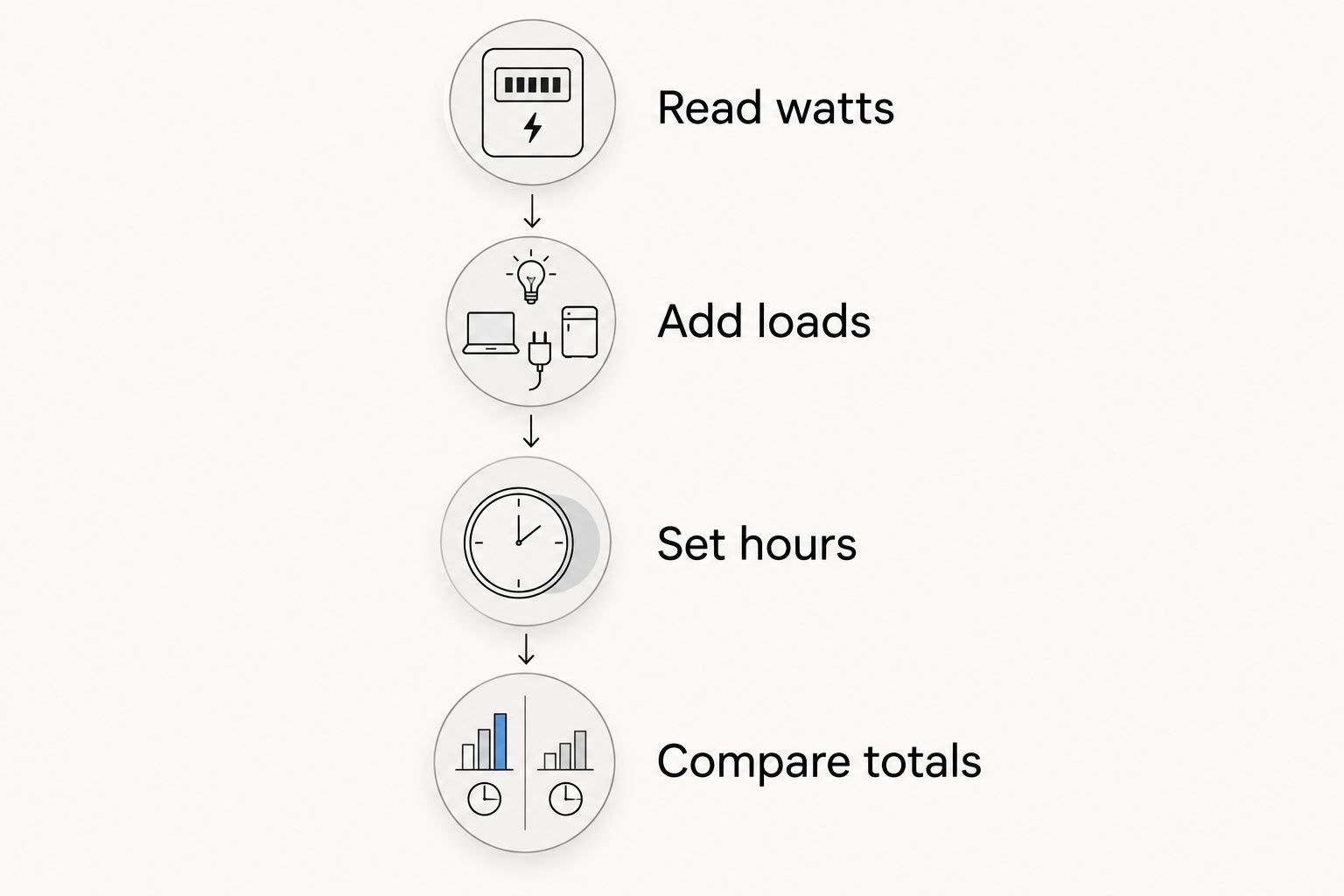
Use this sequence for each proposed display:
- Read watts: Find the input rating for each complete strand or powered assembly.
- Add loads: Add the ratings for all the units you plan to operate together.
- Set hours: Choose the daily operating window and the number of operating days.
- Compare totals: Multiply total watts by operating hours, then divide by 1,000 to calculate kilowatt-hours.
Keep brightness and appearance comparable when reviewing the totals. A dimmer or smaller display is not an equivalent replacement simply because it uses less electricity. The useful question is which layout delivers your chosen effect with less total energy.
If a product uses an external power supply, check the complete system's input information. Do not assume a voltage label is a wattage rating.
How we ranked these lighting formats
LED mini string lights rank first for layout flexibility. The remaining formats each own a distinct job: roofline definition, shrub coverage, hanging detail, or a continuous-looking border.
This is a use-case ranking, not a measured comparison of individual products. The lowest-energy choice is the suitable layout with the lowest verified total wattage and a controlled operating schedule. Outdoor suitability and installation instructions remain requirements, not trade-offs.
Which LED Christmas lights should you choose?
Choose LED mini string lights when you want adaptable detail and have not committed to a particular visual format. Choose C9-style LEDs when the roofline is the priority. Use nets, icicles, and rope lights only when their shapes solve a specific design need.
SOK Lighting is best for homeowners who want Christmas light design, installation, maintenance, takedown, and storage handled together. For your 2026 project, discuss the desired appearance alongside the proposed lighting specifications and operating schedule. Full-service installation and energy performance answer different questions; your plan should address both.
Plan your Christmas light display
Discuss custom design, installation, seasonal maintenance, takedown, and storage.
FAQ
What are the best LED Christmas lights for energy savings?
LED mini string lights are the default choice for flexible, detailed displays, but no format guarantees the lowest energy use. Compare verified total input watts for layouts that deliver the appearance you want, then account for operating hours.
Are LED Christmas lights more energy-efficient than incandescent lights?
LED Christmas lights generally use less electricity than incandescent lights for a comparable lighting task. Compare actual product specifications and complete layouts rather than assuming every LED display uses less electricity than every incandescent display.
Are C9-style LED lights better than mini lights?
C9-style LED lights are better for a defined roofline, while mini lights are better for fine detail and wrapping. Neither format automatically wins on electricity use; total input wattage determines that comparison.
Does a timer reduce Christmas light energy use?
A timer reduces energy use when it shortens the time your display operates. It does not reduce the lights' power draw while they are on, so combine a deliberate schedule with an appropriately sized display.
How do I calculate Christmas light electricity use?
Multiply the complete display's input watts by its total operating hours, then divide by 1,000 to calculate kilowatt-hours. Include every connected strand and use complete-system input information for powered assemblies.
Can I leave outdoor LED Christmas lights on overnight?
Follow the lighting and control manufacturers' instructions for permitted operation. For energy savings, schedule the display to switch off when you no longer want it illuminated rather than making overnight operation the default.
Does SOK Lighting handle removal and storage?
SOK Lighting designs, installs, maintains, takes down, and stores custom Christmas light displays for homeowners in Nampa, Meridian, Boise, and Eagle, Idaho. Discuss your intended display and service scope when planning the project.
One last thing
Before finalizing your 2026 display, identify the feature you most want people to notice. Start there and justify each additional illuminated area. Removing an unnecessary lighting section reduces connected load; choosing a different bulb shape does not automatically do that.