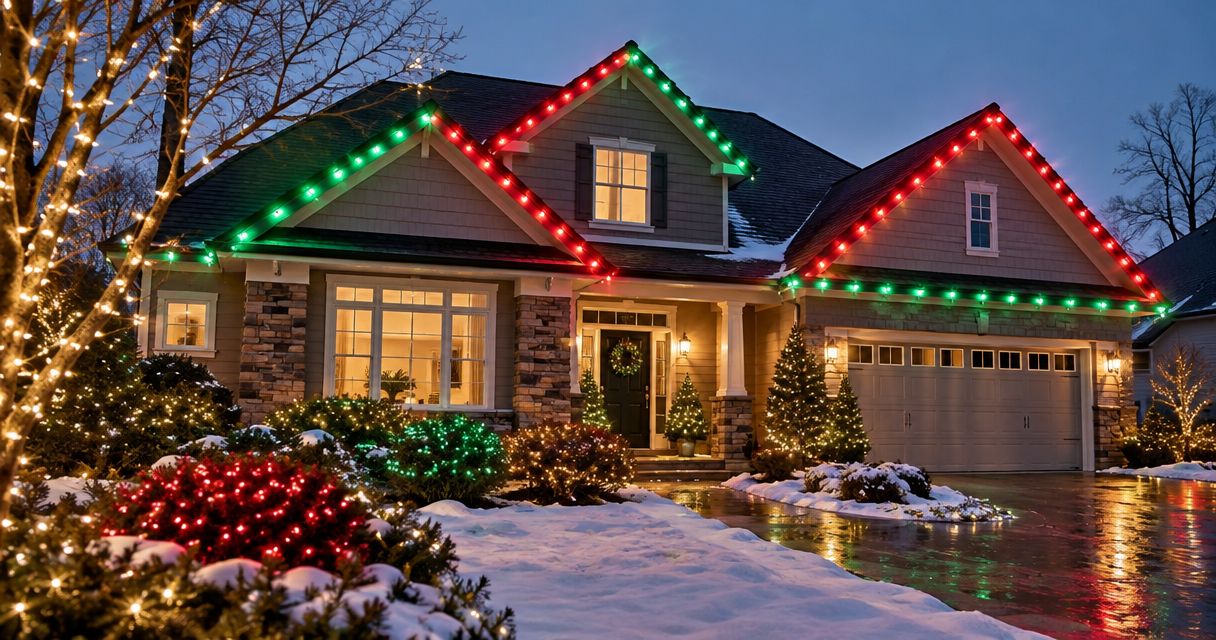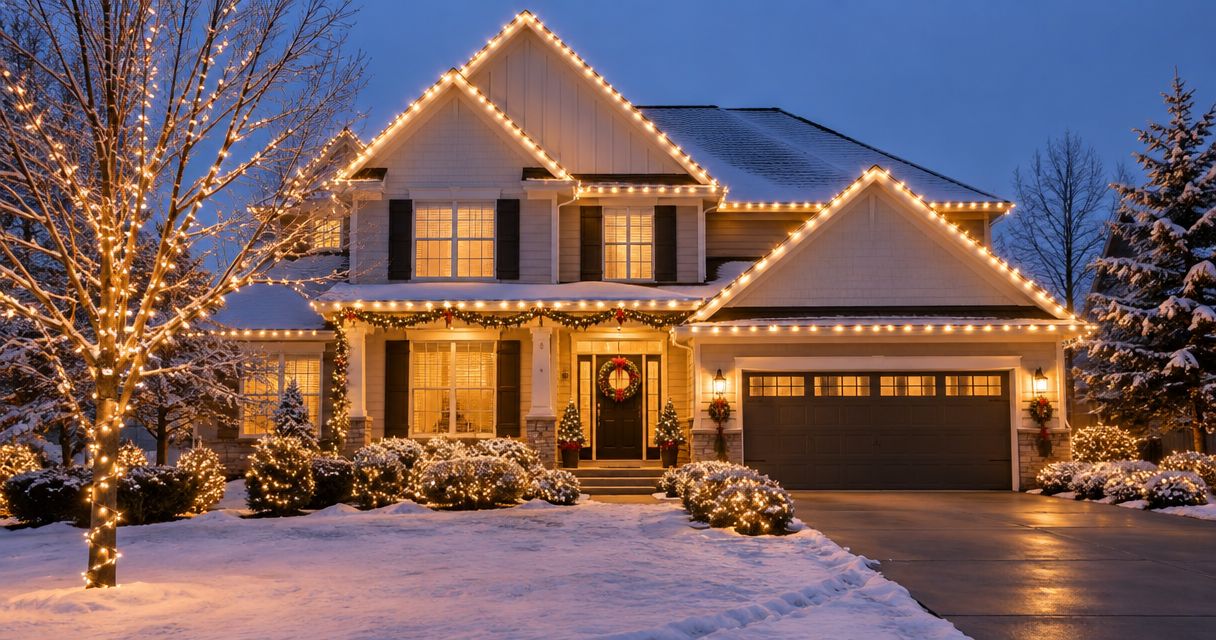
Best overall: a warm-white roofline outline. Best for a playful display: a multicolor roofline. Best for a restrained design: entryway lighting with one upper-story accent. This guide compares the best christmas light styles for two-story homes for 2026, with clear choices for tall façades, layered roofs, and front entrances.
- Warm-white roofline outlines are the best christmas light styles for two-story homes when architectural definition is your priority.
- Multicolor rooflines suit playful displays; icicle lights suit long, uninterrupted eaves.
- Choose one main lighting treatment and one supporting accent rather than treating every surface equally.
- SOK Lighting suits homeowners seeking custom Christmas lighting with installation, seasonal maintenance, takedown, and storage.
Why this matters
A two-story house gives you several places to hang lights, but they do not all need equal attention. Roof peaks, upper windows, garage edges, and porch columns compete when each gets a different treatment. The result is busy rather than intentional.
For your 2026 display, decide what you want people to notice first. A roofline outline emphasizes the house's shape. A bright entrance emphasizes the welcome. Those are different goals, and the best layout starts by choosing between them.
SOK Lighting is best for homeowners who want custom Christmas lighting without handling installation, maintenance, takedown, or storage. Homeowners in Nampa, Meridian, Boise, and Eagle can explore SOK Lighting for that full-service approach. The style recommendations below help you describe the result you want, rather than arrive with a shopping list of unrelated strands.
What makes the best Christmas lighting for a two-story home?
Use these criteria to judge a style before choosing individual lights:
- Architectural fit: Follow a feature your house already has, such as a continuous eave, prominent gable, or framed entrance.
- Visual hierarchy: Pick a main feature and a quieter supporting feature. Do not make every edge the focal point.
- Color consistency: Keep white tones consistent across connected sections. For multicolor designs, repeat a deliberate pattern.
- Street-level readability: Judge the display from the sidewalk or driveway, not only from directly beneath it.
- Service access: Plan installation, troubleshooting, and removal for upper-story sections before choosing them.
- Seasonal upkeep: Choose a layout you are willing to maintain through the season and pack away afterward.
Treat these as selection criteria for 2026, not a requirement to decorate more. A simple design that suits the house beats several unrelated effects competing for attention.
Two-story Christmas light styles at a glance
| Rank and style | Best for | Standout feature | Key limitation |
|---|---|---|---|
| 1. Warm-white outline | Architectural definition | Traces roof edges without adding hanging shapes | Inconsistent white tones interrupt the look |
| 2. Multicolor outline | Playful family displays | Repeating color creates a clear theme | Additional colors can compete with yard decorations |
| 3. Icicle lights | Long, uninterrupted eaves | Adds a hanging fringe below the roof edge | Closely stacked roof levels can look crowded |
| 4. Window outlines | Balanced façades | Repeats a shape across the front elevation | Uneven window arrangements need selective treatment |
| 5. Entryway accents | Restrained displays | Makes the entrance the main focal point | Leaves much of the upper roof undecorated |
| 6. Tree-and-roofline pairing | Landscaped front yards | Connects the house with one landscape feature | Adds another area to install and maintain |
These options describe design directions, not specific products. Choose the treatment that fits your home's strongest feature, then decide how much supporting decoration it needs.
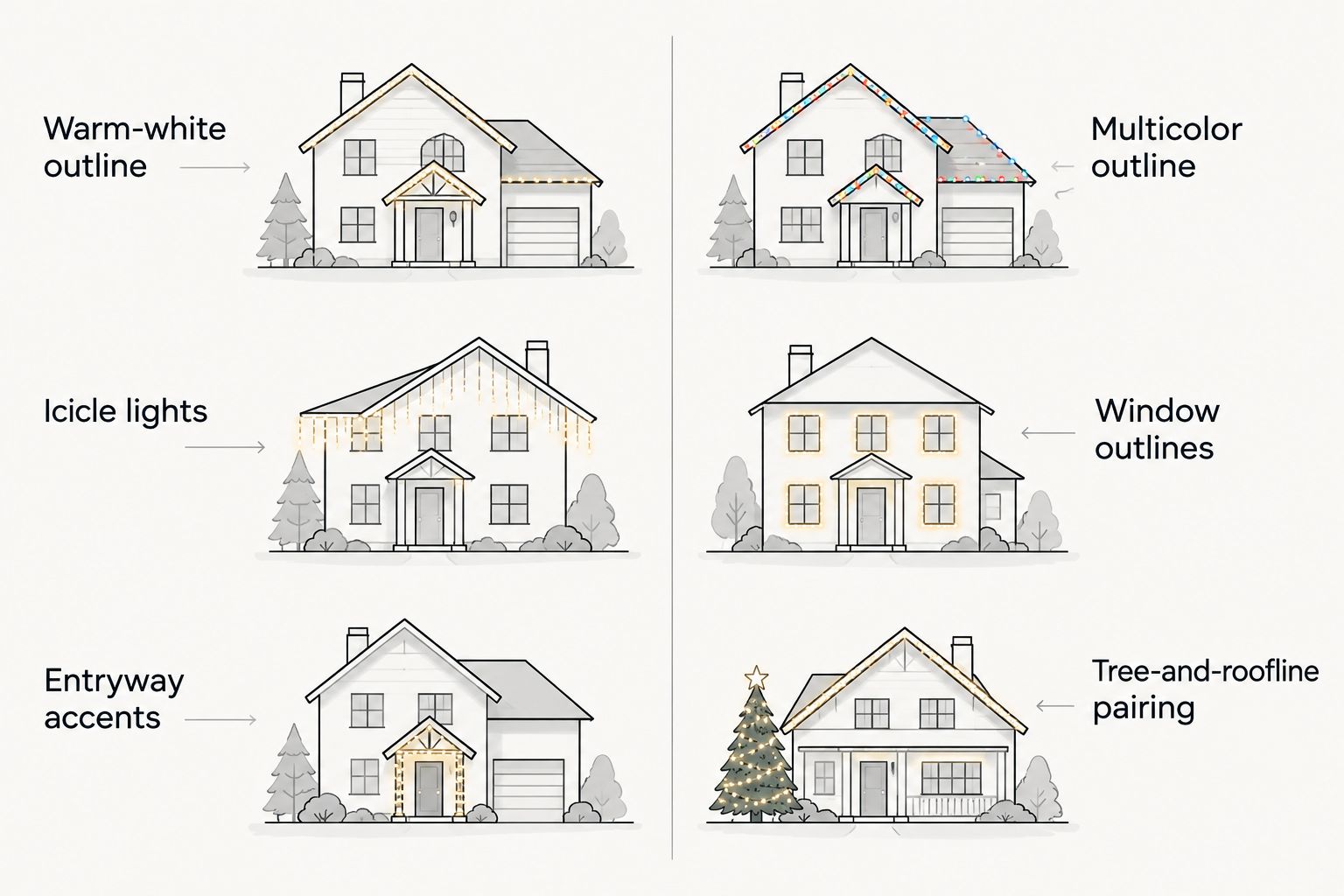
1. Warm-white outline: best for architectural definition
A warm-white outline follows selected roof edges with a consistent light color. On a two-story home, it gives the upper structure a clear outline without adding hanging shapes or several competing colors. It is the default recommendation when you want the house itself to remain the subject.
Start with the roof edges visible from your main viewing position. You do not need to trace every hidden return or rear-facing section to make the front elevation feel complete.
Warm-white outline pros:
- Keeps the roof shape easy to read.
- Gives separate gables a shared visual treatment.
- Supports a simple wreath or entrance accent.
Warm-white outline cons:
- Different white tones are noticeable where sections meet.
- A complex roof can still look crowded if every edge is outlined.
Best for: Homeowners who want a cohesive, architecture-led display.
For your 2026 plan, make the roofline the main feature and keep the entrance subordinate. Verdict: Buy this style as the default choice when you are undecided.
2. Multicolor outline: best for a playful family display
A multicolor outline uses the same architectural approach as a white outline, but makes color the theme. Repeat the color sequence across connected roof sections so the display reads as one design rather than separate strands.
This style suits a house where the lights are meant to feel festive and playful. Keep nearby decorations in the same visual direction instead of adding an unrelated color scheme around each window or shrub.
Multicolor outline pros:
- Gives the roofline a clear, playful identity.
- Repeats easily across separate roof sections.
- Works as the main decorative feature without extra hanging elements.
Multicolor outline cons:
- Several unrelated color patterns compete with one another.
- Extensive yard decorations can distract from the roofline.
Best for: Homeowners who prefer visible color to a restrained white display.
Choose a repeating pattern before discussing individual strands. Verdict: Buy this style when color is the point; skip it when you want the architecture to lead.
3. Icicle lights: best for long, uninterrupted eaves
Icicle lights hang below the roof edge instead of simply tracing it. That fringe changes the silhouette of the house, making a continuous eave the feature rather than the line above it.
Use icicles selectively on a two-story house with roof levels that sit close together. Hanging strands on every level can crowd the space between roofs and windows. A single continuous run is a clearer starting point than several disconnected patches.
Icicle light pros:
- Adds a distinct hanging shape to the display.
- Gives long eaves a repeated decorative treatment.
- Creates variety without requiring several light colors.
Icicle light cons:
- Stacked roof levels can become visually crowded.
- Tangled drops add handling work during removal and storage.
Best for: Homes with a prominent, uninterrupted eave visible from the street.
Keep other roof treatments quiet where the hanging fringe already draws attention. Verdict: Buy this style for a suitable eave; skip it when short, overlapping roof sections dominate.
4. Window outlines: best for balanced front façades
Window outlines repeat a rectangular shape across the front of the house. They suit a two-story façade where aligned or regularly spaced windows provide the structure for the display.
Choose the windows as a group rather than decorating whichever opening is easiest to reach. A deliberate selection looks more coherent than leaving an unexplained gap in an otherwise repeated pattern.
Window outline pros:
- Draws attention to the façade rather than only the roof.
- Creates a repeatable pattern across both stories.
- Offers a clear design direction for homes with modest roof details.
Window outline cons:
- Irregular window spacing makes repetition less straightforward.
- Upper-story installation still requires an access plan.
Best for: Homes with balanced window placement and a front elevation worth emphasizing.
For 2026, consider window outlines as the main treatment, not an automatic addition to a fully outlined roof. Verdict: Buy this style when the window arrangement provides a clear pattern.
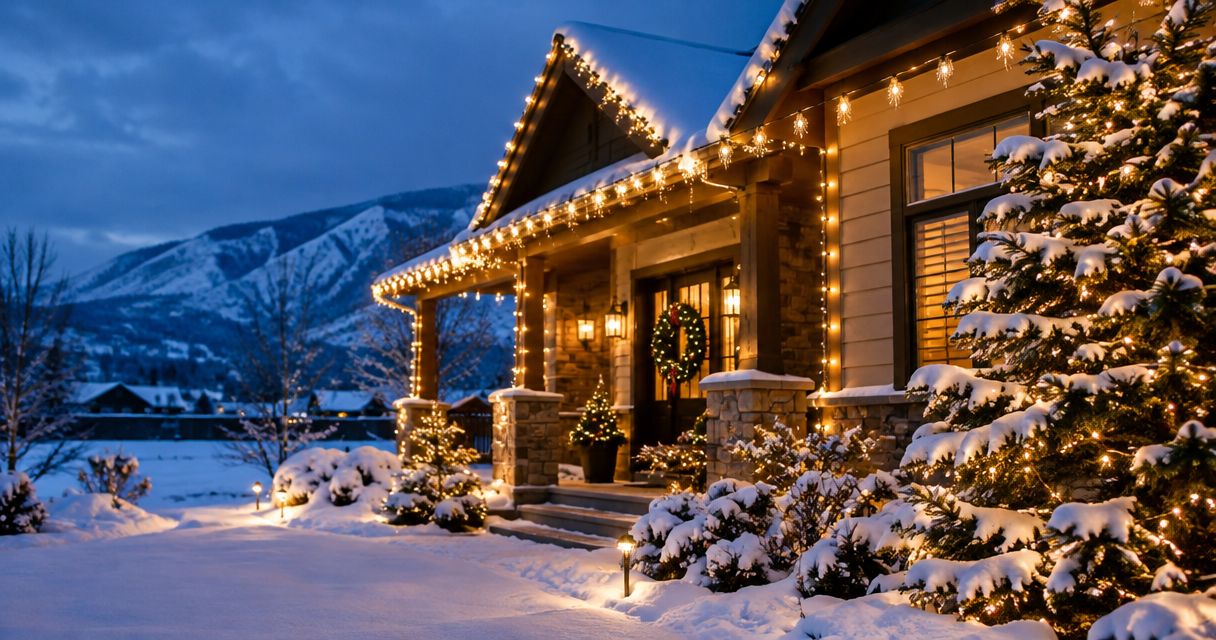
5. Entryway accents: best for a restrained display
An entry-led design concentrates light around the front door, porch, or nearby columns. Add one upper-story accent if you want a visual connection to the second floor without outlining the entire house.
This is a design choice, not an unfinished roofline display. The entrance gets the attention, while the undecorated areas provide contrast. Choose the upper accent from an existing feature, such as a central window or a gable above the door.
Entryway accent pros:
- Makes the front entrance easy to identify visually.
- Limits the number of separate decorated areas.
- Gives you a clear stopping point for the design.
Entryway accent cons:
- Does not define the full upper roofline.
- A recessed entrance needs careful evaluation from the street.
Best for: Homeowners who want a focused display rather than a fully decorated façade.
Keep the entrance dominant; the upper accent should support it. Verdict: Buy this style when restraint matters more than coverage.
6. Tree-and-roofline pairing: best for landscaped front yards
A tree-and-roofline pairing combines a simple roof outline with one selected landscape feature. The house remains part of the composition, but the display extends into the yard instead of adding more effects to the façade.
Choose a tree or shrub that is clearly visible from your main viewing position. You do not need to decorate every plant. Leave visual separation so the landscape lighting and roofline remain distinct.
Tree-and-roofline pairing pros:
- Connects the house and front yard visually.
- Adds a focal point below the upper roof.
- Lets the roofline treatment stay simple.
Tree-and-roofline pairing cons:
- Adds another area to install, inspect, and remove.
- A poorly positioned landscape feature can compete with the entrance.
Best for: Homes with a prominent front-yard tree or shrub that belongs in the view.
Keep the landscape feature intentional rather than expanding into every planting bed. Verdict: Buy this style when the yard strengthens the composition; skip it when the house already supplies enough detail.
How these styles rank
The ranking prioritizes architectural fit, clear visual hierarchy, and a coherent view from the street. Warm-white outlines lead because they provide a direct way to define the house without adding another decorative shape. The remaining choices win for specific features or preferences, not because every home needs them.
This is a design ranking, not a product test. Your roof shape, window arrangement, and preferred viewing angle determine which recommendation belongs first for your house.
Which Christmas light style should you choose?
Choose a warm-white roofline outline if you want a dependable starting direction. Move to multicolor when playfulness matters most, icicles when you have a strong continuous eave, or window outlines when the façade has a clear repeating pattern.
Before approving your 2026 layout, make these decisions:
- Main feature: Name the part of the house that should draw attention first.
- Supporting feature: Add one quieter accent, or choose none.
- Color direction: For a restrained design, limit the plan to 1 white tone or 2 selected colors.
- Coverage: Start with 2 lighting zones, such as the roofline and entrance, before adding more.
- Seasonal handling: Decide who handles upkeep, removal, and storage before installation.
SOK Lighting designs custom Christmas lighting and handles installation, seasonal maintenance, takedown, and storage. Describe the look you want and the parts of the seasonal work you want off your list. That keeps the discussion focused on your home rather than a generic display.
Plan your Christmas light display
Discuss custom design, installation, seasonal maintenance, takedown, and storage for your home.
FAQ
What's the best Christmas light style for a two-story home?
A warm-white roofline outline is the best default when you want to emphasize the home's architecture. Choose a different style when a long eave, balanced windows, or a prominent entrance gives you a stronger focal point.
Are multicolor lights better than white lights on a tall house?
Multicolor lights are better for a playful display; white lights are better for a restrained architectural outline. Height alone does not determine the choice. Use a consistent pattern across the roof sections you decorate.
Do icicle lights look good on two-story homes?
Icicle lights suit two-story homes with long, uninterrupted eaves. Use them selectively when several roof levels sit close together, because hanging drops can crowd the space between those levels.
Should I decorate both stories of my house?
You do not need to decorate both stories equally. Choose a main feature, then use a quieter upper or lower accent if it helps the composition. An entry-led display can leave most of the roof undecorated.
Can I mix warm-white and cool-white Christmas lights?
You can mix white tones deliberately, but a consistent tone is the clearer choice for a continuous roofline. Avoid an unintended change where connected sections meet. Judge the combination from your normal viewing position.
How do I plan lights for a second-story roof?
Plan upper-story access, electrical connections, maintenance, and removal before installation. Follow the equipment and lighting manufacturers' instructions. Do not treat a design guide as instructions for working at height.
Who handles Christmas light removal and storage in Boise?
SOK Lighting provides custom Christmas lighting with installation, seasonal maintenance, takedown, and storage for homeowners in Boise, Nampa, Meridian, and Eagle. Discuss your home's layout and desired style when planning the display.
One last thing
Judge your layout from where you will actually see it. Stand across the street or at the driveway entrance and identify the first feature your eye lands on. If you cannot name it, simplify the plan before adding another strand.
For 2026, keep one photograph of the undecorated house with your chosen roof sections and accents marked. That gives you a concrete reference for the design discussion and a clearer stopping point than deciding strand by strand.