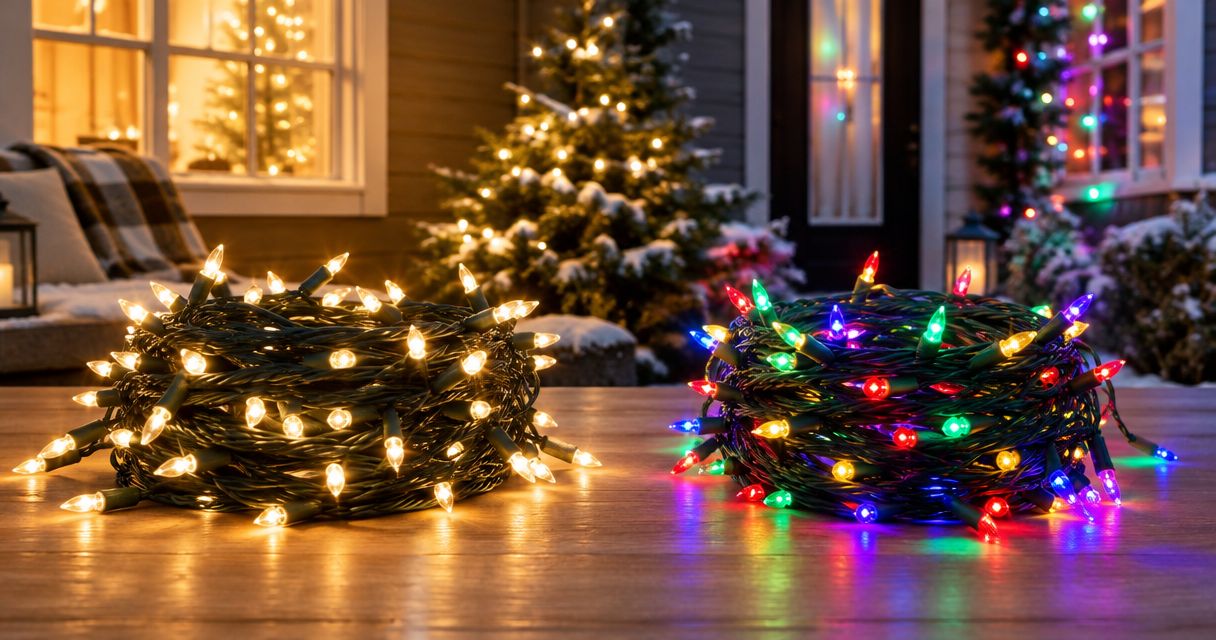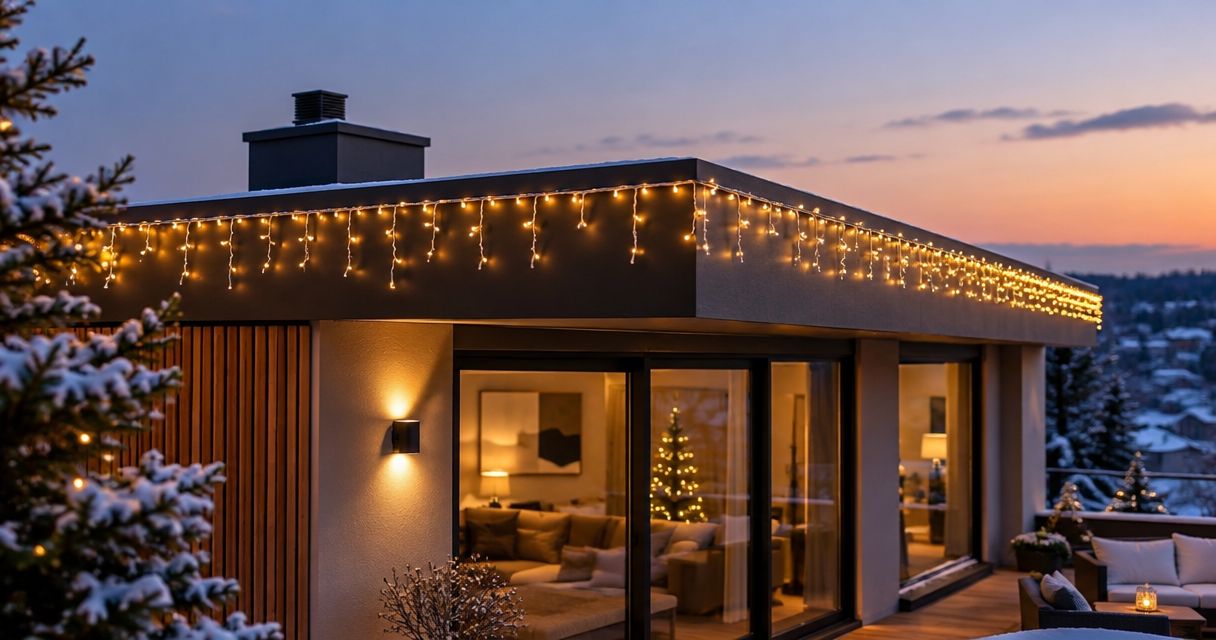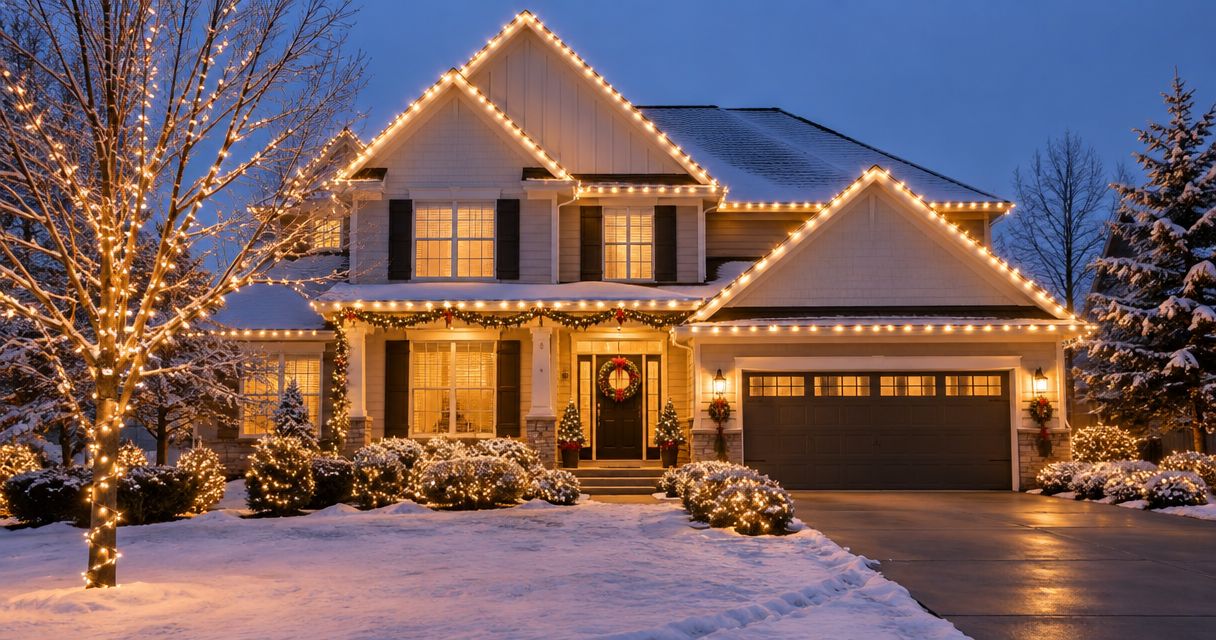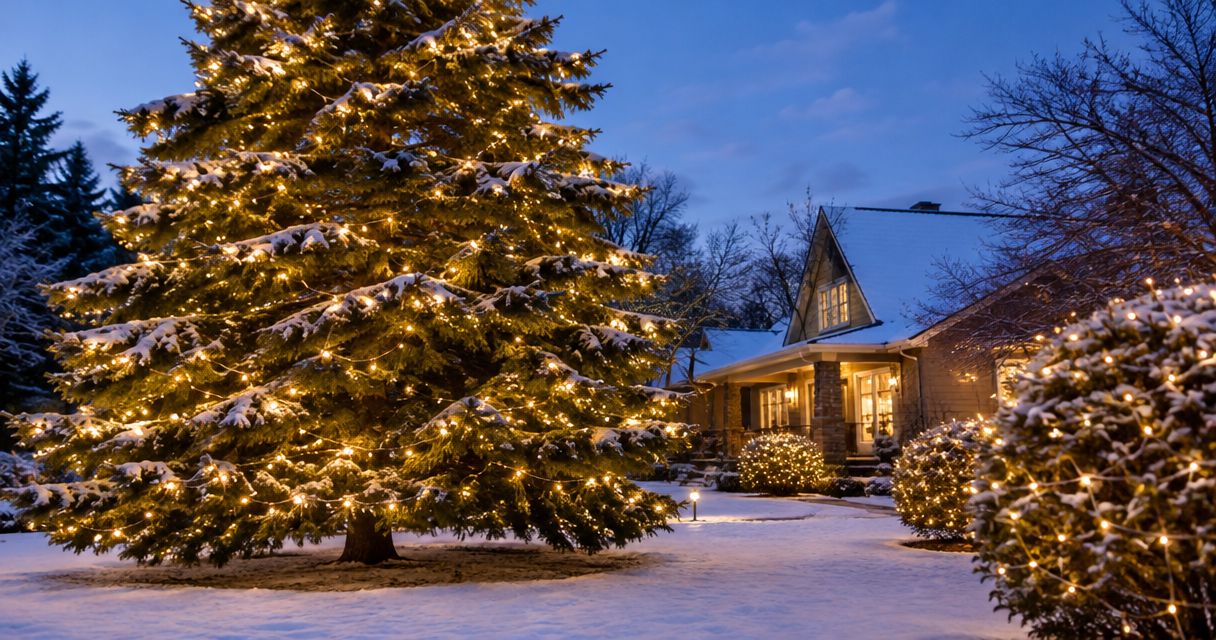
Best overall for branching trees: outdoor LED mini string lights. Best for rounded shrubs: net lights. Best for tall evergreen silhouettes: large-bulb strings. The best Christmas lights for trees and shrubs in 2026 match the plant’s shape; homeowners who want installation, maintenance, takedown, and storage handled can choose SOK Lighting in Nampa, Meridian, Boise, and Eagle.
- The best christmas lights for trees and shrubs match plant shape: mini strings for branches, nets for rounded shrubs.
- Large-bulb strings suit evergreen silhouettes; cluster lights suit concentrated accents; rope lights suit simple trunk outlines.
- SOK Lighting is best for homeowners who want custom Christmas lighting with installation, maintenance, takedown, and storage handled.
- Choose outdoor-rated lights, check connection limits, and plan removal before wrapping a tree.
Why this matters
A light strand that looks right on a roofline does not automatically suit a shrub. Bulb size, spacing, and the way the wire follows the plant determine whether you see a clean outline or a tangle of bright patches.
Start your 2026 display with the planting, not the package. A bare deciduous tree needs a different approach from a dense evergreen or a low hedge. Choosing the right format also makes installation and removal less awkward.
What makes the best Christmas lights for trees and shrubs?
Use these criteria before comparing light styles:
- Plant fit: Match flexible strings to branching shapes and nets to surfaces they can cover without stretching.
- Outdoor suitability: Use lights, connectors, and supporting electrical equipment labeled for the intended outdoor use.
- Viewing distance: Choose fine points for close detail and more distinct bulbs when the outline needs to read from farther away.
- Connection limits: Follow the manufacturer’s limits for connected strands and electrical loading. LED lights do not remove those limits.
- Removal access: Choose a layout you can take down without pulling through branches or climbing beyond your equipment’s reach.
- Seasonal workload: Include setup, troubleshooting, takedown, and storage in the decision—not just the evening appearance.
The best format follows the plant without forcing the plant to fit the lights. Do not tightly bind branches or use the wiring to pull foliage into position.
Christmas tree and shrub lights at a glance
These are format recommendations, not rankings of specific manufacturers. Outdoor suitability and connection instructions still depend on the exact product you choose.
| Rank and option | Best for | Standout feature | Key limitation |
|---|---|---|---|
| 1. LED mini string lights | Branching deciduous trees | Flexible routing around trunks and limbs | Detailed wrapping takes time to remove |
| 2. Net lights | Rounded shrubs and regular hedges | Connected mesh distributes lights across a surface | Poor fit exposes the grid or leaves gaps |
| 3. Large-bulb strings | Tall evergreen silhouettes | Distinct points define the outer shape | Less suited to fine branch detail |
| 4. Cluster lights | A concentrated focal shrub | Closely grouped lights create a dense accent | Easy to overpower nearby planting |
| 5. Rope lights | Simple trunk outlines | A continuous-looking line follows a basic shape | Not suited to intricate branching |
1. LED mini string lights: best for branching deciduous trees
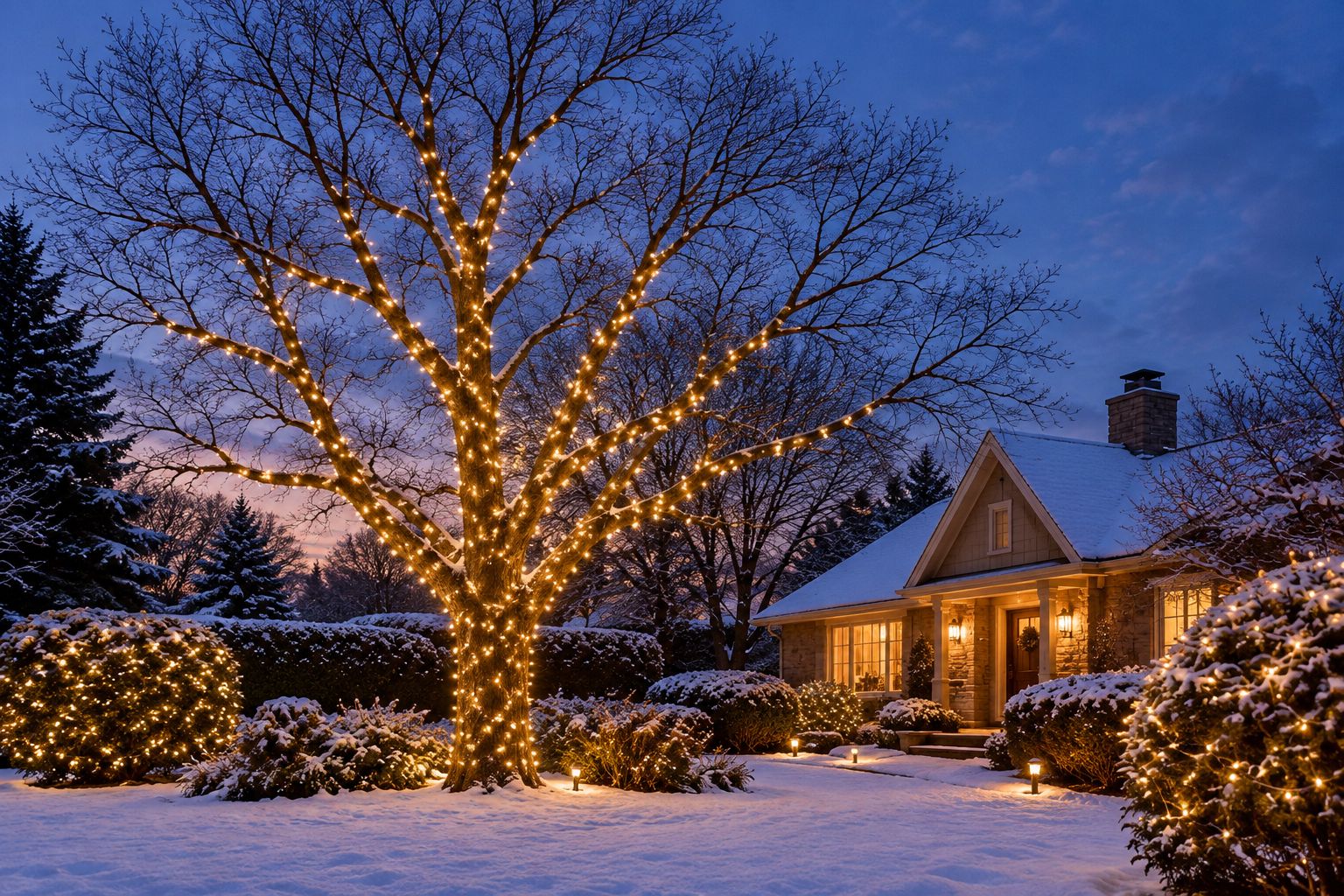
Outdoor LED mini string lights are the default choice for a tree with a visible trunk and branching structure. Their flexible wire lets you follow the architecture rather than drape a bright curtain across it.
For your 2026 layout, decide whether you want a trunk accent, selected major limbs, or more extensive branch coverage. Those are different installation commitments. Start with the parts that are visible from your main viewing position.
LED mini string lights pros:
- Follow irregular trunks and branches more naturally than mesh.
- Support either restrained accents or more detailed wrapping.
- Let you emphasize selected limbs instead of covering the whole canopy.
LED mini string lights cons:
- Detailed wrapping creates more work during takedown.
- Higher branches require appropriate access equipment and safe working conditions.
- Wires disappear into bark and twigs, making careless removal difficult.
Best for: Homeowners who want the structure of a leafless tree to remain the main feature.
Keep wraps loose enough that the wire does not bind the bark. Plan the route back to the power connection before climbing, and do not leave seasonal strands in place as the tree grows.
Verdict: Buy outdoor LED mini strings for branching trees; skip intricate wrapping where removal would be unsafe.
2. Net lights: best for rounded shrubs and regular hedges
Net lights connect strands into a mesh that rests over foliage. They work best when the shrub’s surface resembles the net’s overall shape, so the lights settle across it without bunching.
A rounded shrub or relatively even hedge is a better candidate than an open, irregular plant. Measure the coverage area before choosing a net. Stretching a small net across a large shrub does not create even coverage.
Net lights pros:
- Spread light points across a broad surface.
- Reduce the need to route individual strands around every branch.
- Suit repeated shrubs when you want a consistent treatment.
Net lights cons:
- Edges and mesh become conspicuous when the fit is wrong.
- Sparse foliage leaves less support for the grid.
- Removal requires patience where small branches catch the mesh.
Best for: Rounded shrubs, dense foundation planting, and hedges with regular surfaces.
Place the net gently rather than pressing it deep into the plant. Check the result from the sidewalk before fastening it, and keep connections accessible instead of burying them in foliage.
Verdict: Buy net lights for dense, regular shrubs; skip them on open or strongly irregular plants.
3. Large-bulb strings: best for tall evergreen silhouettes
Large-bulb strings create distinct points around an evergreen’s outer shape. Choose them when you want the tree’s outline to read clearly rather than show fine detail inside its branches.
For a 2026 evergreen display, follow a deliberate route around the visible canopy. Do not scatter bulbs wherever branches happen to be easiest to reach. An intentional outline is easier to read than disconnected patches.
Large-bulb strings pros:
- Make individual light points visually distinct.
- Emphasize the broad silhouette of an evergreen.
- Offer a different scale from small lights used on nearby shrubs.
Large-bulb strings cons:
- Look coarse when used for delicate branch wrapping.
- Require attention to secure placement and the product’s support instructions.
- Do not solve the access problem on a tall tree.
Best for: Evergreens where the outer shape matters more than interior branch detail.
Large bulbs are a visual choice, not permission to connect more strands. Check the actual product’s electrical requirements and connection limit; bulb appearance alone tells you neither.
Verdict: Buy large-bulb strings for evergreen outlines; skip them when you want subtle branch detail.
4. Cluster lights: best for a concentrated focal shrub
Cluster lights group many light points closely along a strand. They suit a deliberate accent where you want a shrub or small planting area to draw attention.
Use the density selectively. If the entrance shrub is the focal point, nearby planting can stay quieter instead of competing with it.
Cluster lights pros:
- Create a concentrated patch of light.
- Help distinguish a focal shrub from surrounding planting.
- Offer a textured alternative to a regular net pattern.
Cluster lights cons:
- Dense light placement can overwhelm a small garden scene.
- Closely grouped wiring takes care to separate and store.
- The strand still needs routing; it does not automatically cover a shrub evenly.
Best for: A focal shrub near an entrance or another clearly chosen visual anchor.
Look at the arrangement from indoors as well as from the street. A bright accent beside a window affects the view from the room, not just the curb.
Verdict: Buy cluster lights for a deliberate focal accent; skip them as the automatic choice for every shrub.
5. Rope lights: best for simple trunk outlines
Rope lights place light sources inside a flexible outer tube. They create a continuous-looking line rather than the separated points associated with conventional strings.
That makes them a specialized choice for a simple trunk treatment, not the default for an entire tree. Follow the product’s bending and fastening instructions; forcing tight curves works against this format.
Rope lights pros:
- Produce a clear linear effect.
- Suit a simple route along a relatively uncomplicated trunk.
- Provide a visibly different treatment from dotted branch lights.
Rope lights cons:
- Handle intricate branching poorly.
- Make the tubing itself part of the visible installation.
- Have product-specific restrictions on bending, cutting, and connections.
Best for: A simple trunk outline where a continuous line is the intended look.
Do not assume rope lights can be cut, shortened, or joined wherever convenient. Only make modifications explicitly permitted by the manufacturer.
Verdict: Buy rope lights for simple linear accents; skip them for detailed tree wrapping or shrub coverage.
Plan the display before choosing strands
A useful 2026 planning exercise is to treat each plant as a separate lighting zone. For example, 2 trees and 4 shrubs create 6 planning zones—not a reason to buy the same lights for all of them.
Give each zone a job: outline, branch detail, broad coverage, or focal accent. Then decide where power reaches it and how you will retrieve the lights after the holidays.
Check the proposed layout from 3 viewing positions: the street, the front walk, and an indoor window. This is a planning recommendation, not a lighting standard. It helps you avoid building a display that works only from the spot where you installed it.
Before installation:
- Inspect wiring and remove damaged sets from use.
- Use outdoor equipment with ground-fault circuit-interrupter protection as directed by applicable safety guidance.
- Keep electrical connections out of standing water.
- Follow every strand’s connection and loading instructions.
- Keep ladders on stable footing and away from overhead electrical lines.
- Stop when a branch is beyond safe reach; do not improvise an extension of your ladder.
When full-service installation is the better choice
Choose full service when you want the decorated yard without taking on ladders, troubleshooting, takedown, and tangled strands in storage. SOK Lighting provides custom Christmas lighting design, installation, seasonal maintenance, removal, and storage for homeowners in Nampa, Meridian, Boise, and Eagle.
SOK Lighting is best for homeowners who want custom Christmas lighting with installation, maintenance, takedown, and storage handled. That is a service recommendation, not a claim that a particular bulb style suits every property.
The trade-off is control over the hands-on work. DIY suits homeowners who enjoy arranging and maintaining their own display; full service suits homeowners who want those tasks handled. Describe your trees, shrubs, and desired focal points before settling on the design.
Plan your Christmas lighting
Discuss a custom display with design, installation, seasonal maintenance, takedown, and storage.
How these light formats are ranked
The order prioritizes plant fit, visual purpose, outdoor suitability, connection requirements, and removal access. Mini strings lead because they suit branching tree shapes; nets lead specifically for regular shrub surfaces. This is a format-based buying guide, not a hands-on product test or a manufacturer reliability ranking.
Which Christmas lights should you choose?
Choose outdoor LED mini strings for branching trees and net lights for rounded shrubs. That combination is the clearest starting point for your 2026 plan. Add large bulbs for evergreen outlines, cluster lights for a focal shrub, or rope lights only when a continuous trunk line is the intended effect.
If installation and storage are the obstacles, choose SOK Lighting for custom Christmas lighting service rather than buying a format that still leaves you with the same seasonal chores.
FAQ
What are the best Christmas lights for trees and shrubs?
Outdoor LED mini string lights are the default for branching trees, while net lights suit rounded shrubs. Use large-bulb strings for evergreen silhouettes and cluster lights for concentrated accents.
Are net lights better than string lights for bushes?
Net lights are better suited to dense bushes with regular surfaces. Flexible string lights give you more control on irregular plants where a net would bunch or leave gaps.
What lights should I use on a large evergreen tree?
Large-bulb strings suit a large evergreen when you want to emphasize its silhouette. Choose a safe installation route and follow the exact product’s connection and support instructions.
Can I use indoor Christmas lights on outdoor shrubs?
Use lights labeled for outdoor use on outdoor shrubs. Check extension cords, connectors, and controls for the intended outdoor conditions too.
How many Christmas light strands do I need for a tree?
Determine strand quantity from the tree’s dimensions, your wrapping route, and the selected strand’s lit length. A trunk accent and a detailed branch wrap require different amounts, so plant height alone is not enough.
Can I leave Christmas lights wrapped around a tree all year?
Remove seasonal lights rather than leaving tight wraps around a growing tree. Follow the product’s installation instructions and check that wires and fasteners are not binding branches.
Who handles Christmas light installation and storage in Boise?
SOK Lighting designs, installs, maintains, removes, and stores custom Christmas light displays for homeowners in Boise, Nampa, Meridian, and Eagle. The service covers the seasonal work rather than only the initial installation.
One last thing
Choose your removal route before your installation route. A strand that threads neatly through fine branches in December still has to come back out. Leave connections accessible, record the layout, and store each zone separately so the next installation starts with a plan instead of a knot.